


Green Product
Green Product



- 13
- 12

Green Products
The Company places importance on the green design, uses the eco-design approach, and takes the environmental impact and carbon reduction into account at the design stage. A carbon footprint report is produced via the management platform and the Company takes follow-up and management measures for the performance of the carbon reduction.
Green Product Management Structure

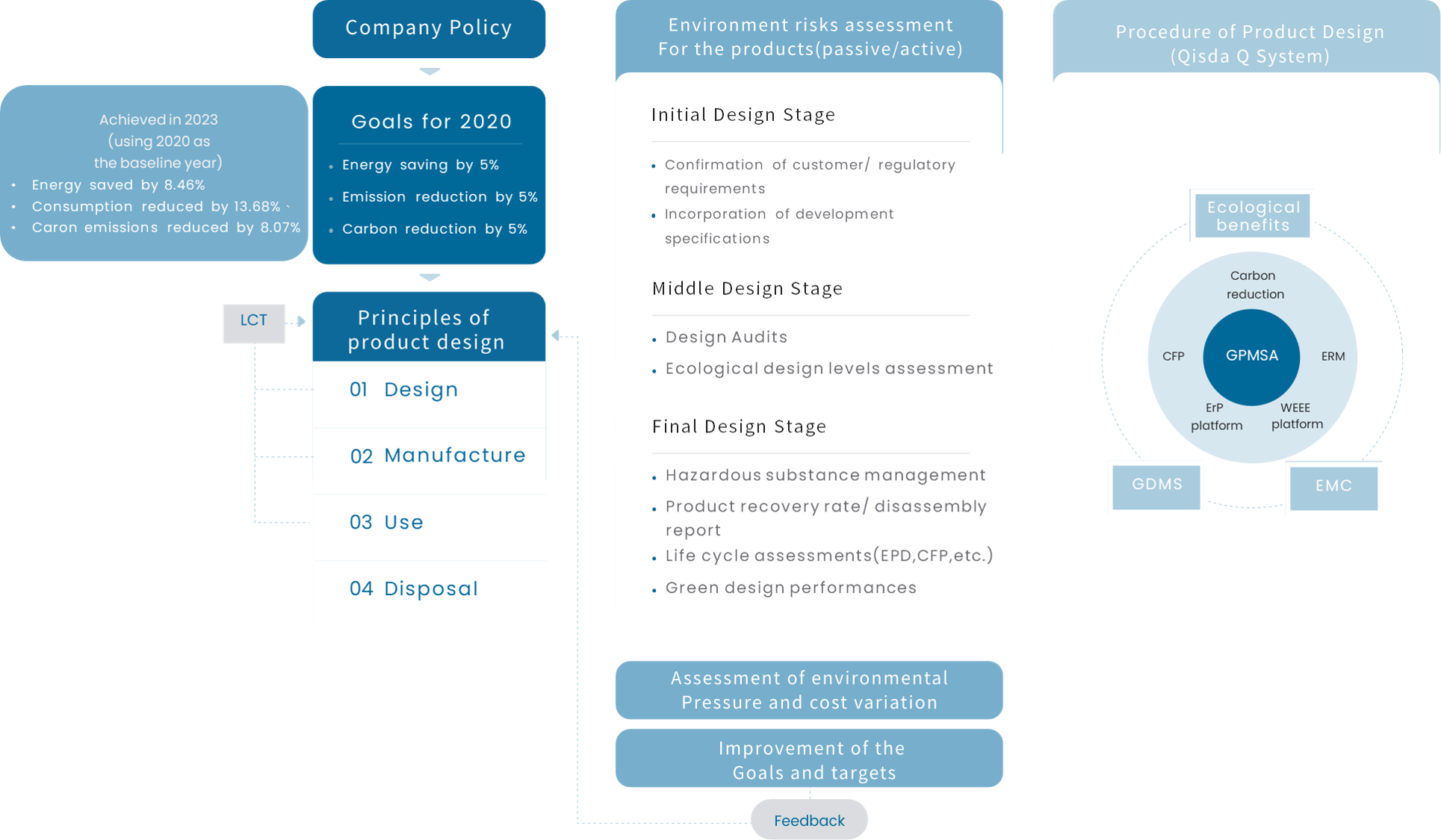
Qisda's Structure of Incorporated Ecological Design
Qisda applies life cycle thinking to all stages of product design and R&D, setting up goals for green design from the beginning of the design process.
Moreover, we continue to enhance our products each year, improving the energy efficiency of the products and reducing resource consumption by doing so. In 2025, 82.5% of monitors shipped met ENERGY STAR energy efficiency standards, while newly developed projectors achieved a 7.1% improvement in energy efficiency.
Sustainable Materials
Qisda continues to collaborate with its customers in setting targets for sustainable and recycled materials. For example, for a major display customer, the target for new models launched in 2025 was to use at least 85% recycled plastic in the housing. This target was successfully achieved in 2025. Qisda's "Sustainable Materials Policy" defines sustainable materials as those that impose minimal and least harmful impact on the global environment and human health throughout the stages of raw material extraction, product manufacturing, distribution, usage, and end-of-life disposal. The The Sustainable Materials Policy was approved by the Board of Directors and is implemented and promoted by the ESG Committee, with the Board of Directors serving as the highest-level decision making and governance body.
Employees and Society ESG Sustainability Performance Sustainability Disclosure Concrete implementation of Sustainable Materials Policy
- Focus on the environmental impacts of raw material production processes and require suppliers to reduce the negative sustainability impacts associated with raw materials.
- Avoid the use of raw materials sourced from globally or nationally recognized biodiversity sensitive areas.
- Collaborate with external stakeholders to pursue best practices in sustainable raw material sourcing.
- Increase the use of third-party certified sustainable raw materials.
- Increase the use of recycled materials without compromising product quality.
- Consider social impacts in raw material procurement and avoid violations of human rights or harm to local community rights and development.
In Qisda's "Green Product Design Procedure", R&D personnel are required to follow Qisda's Green Design Guidelines. During the product design and development stage, they must adhere to four key green design principles: material reduction, hazardous substance management, energy conservation, and recyclability. Material selection is also carried out in alignment with these green design directions.
Qisda identifies and evaluates environmental aspects and impacts of products in accordance with the “ Impact Source and Risk Identification Management Procedure. ” The Company conducts annual internal and external audits in compliance with IEC 62430, ISO 14006, and ISO 14001. The purpose is to reduce environmental impacts from raw materials through the selection of environmentally friendly materials, for example, reducing the use of mercury lamps in projector products. Each year, online green design and sustainable materials training courses are organized for R&D personnel. The training content covers life cycle concepts, application of life cycle thinking, green product redesign, and green product architecture and elements. Concepts such as circular economy and the use of recycled materials are also incorporated into the curriculum. (For details, please refer to Training for Green Talents.)
Qisda has planned a biodiversity survey across its value chain, extending the scope to include assessments of both suppliers and customers. This initiative aims to understand the company's high dependency and impact on natural capital throughout its operations, identify actual or potential risks and opportunities during the business lifecycle, and avoid human rights violations or harm to the rights and development of local communities, thereby minimizing social impacts.
- Suppliers, unique specifications, and the material composition of raw materials can be traced through the company's internal GPMSA system, and source information is obtained from upstream suppliers to meet customer needs.
Qisda requires its suppliers to comply with the "Code of Conduct for Sustainable Development of Suppliers," which covers labor, health and safety, environment, ethics, and management systems. Suppliers are also required to avoid human rights violations and any harm to the rights or development of local communities when sourcing raw materials. In the environmental dimension, the Code further includes commitments related to no-deforestation and biodiversity protection, aiming to reduce environmental and social impacts. All suppliers are required to fully understand the content of the "Code of Conduct for Sustainable Development of Suppliers" and comply with its requirements. Qisda also conducts supplier audits, including assessments of whether human rights policies properly address forced labor, child labor, young workers, anti-discrimination, anti harassment, and freedom of association. Regarding deficiencies identified during audits, suppliers are required to create corrective action plans within a specified timeframe. Additionally, we offer improvement suggestions and guidance for prompt resolution.
For the highest revenue-generating display model in 2025, the composition of materials used is as follows:
| Material | Consumption (KG) | Recycling Proportion |
|---|---|---|
| Plastic | 5,684,093 | 41.01% |
| Aluminum | 1,285,497 | 94.56% |
| Cobalt | 102 | 0% |
| Copper | 611,775 | 0% |
| Steel | 6,603,592 | 17.66% |
| Nickel | 13,704 | 0% |
| Lithium1 | - | 0% |
| Titanium | 5,402 | 0% |
- No lithium is used in products.


Want to know more detailed content?
Read Report Contents