


Recruitment and Retention
Recruitment and Retention



- 9
- 8

Employee Benefits
With the concept of creating a workplace of health and well-being, Qisda has promoted the diverse employee welfare so that all the employees experience a premium working environment and a corporate culture that brings a sense of health and well-being.
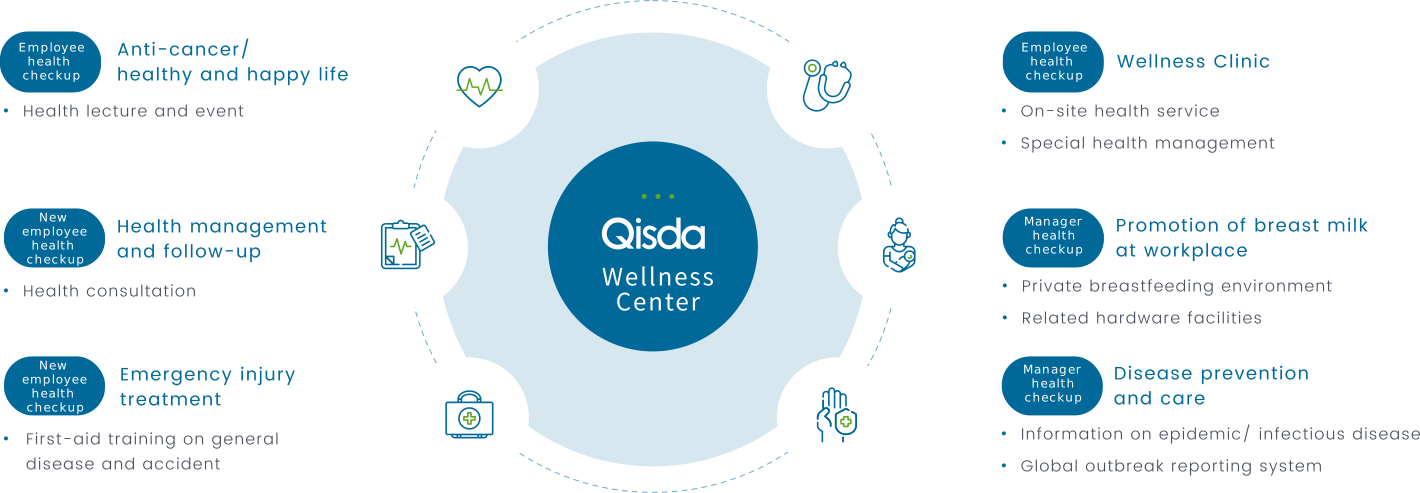
To further enhance employee health management, Qisda has Wellness Centers in both Taiwan and Suzhou, China, with the ultimate goal of promoting the well-being of our colleagues. The Wellness Center organized health promotion events in six facets depending on the problems and needs of the employees with respect to their health: Wellness Clinic, workplace breast milk program disease prevention and care, emergency injury treatment, health management and follow-up, and healthy and happy life.
Qisda's health management model

Employee Payment and Pension
We refer to the wage survey report of a third-party remuneration consultant and the business status of the Company every year, and review the achievement of the goal at the end of the year. As for the compensation to the senior managers, the Compensation Committee reviews the achievement of relevant performance indicators at the meeting and determines the scope of the annual compensation.
Qisda follows the regulations and systems of retirement all over the world and protects the rights of the employees who are planning to retire. The Company makes a contribution to the pension fund for the employees every month and remit it to the labor pension reserve fund account at the Bank of Taiwan in the name of the Labor Pension Fund Supervisory Committee.
Gender Pay Indicators
| Employee Level | Average Women Salary | Average Men Salary | Ratio (Female to Male ) |
|---|---|---|---|
| Executive level (base salary only) | 1,284,582 | 1,385,239 | 0.93 |
| Executive level (base salary + other cash incentives) | 4,563,008 | 4,302,638 | 1.06 |
| Management level (base salary only) | 706,080 | 710,248 | 0.99 |
| Management level (base salary + other cash incentives) | 1,471,867 | 1,468,349 | 1.00 |
| Non-management level (base salary only) | 276,141 | 344,873 | 0.80 |
Remarks:
- The data above is the ratio of average salary and remuneration of full-time women to men throughout 2025.
- Executive level:Director and above
- Management level:Assistant Manager and above, excluding Executive-level positions
- Coverage includes employees with less than one year of tenure.
- Scope of Data Coverage: Qisda (Parent Company), Qisda Suzhou, Qisda Vietnam.
Creating a Happy and Healthy Workplace
Employees are the long-term capital and the supporting capacity for innovation of a company. Qisda has a well-established training system and is dedicated to the improvement of the talent retention rate in order to strengthen the competitiveness of the Company in the industry. For this, we are committed to providing the employees with a complete work environment, and regularly reviewing and timely moderating the employee management rules with reference to the regulations at the regions where the Company is located and the business conditions, enhancing the employee solidarity with the Company by maintaining good work conditions and atmosphere.
Employee Benefit
Qisda follows the regulations and systems of social insurance all over the world to protect the basic rights of the employees.
| Region | Offered According to Laws | Regular Benefits | Better Than Legal Requirements | ||||||||||||||||||||||||||||||||||||||||||||||||
|---|---|---|---|---|---|---|---|---|---|---|---|---|---|---|---|---|---|---|---|---|---|---|---|---|---|---|---|---|---|---|---|---|---|---|---|---|---|---|---|---|---|---|---|---|---|---|---|---|---|---|---|
| Taiwan |
|
|
| ||||||||||||||||||||||||||||||||||||||||||||||||
| Taiwan (Group Companies) |
|
| |||||||||||||||||||||||||||||||||||||||||||||||||
| Suzhou,China |
|
|
| ||||||||||||||||||||||||||||||||||||||||||||||||
| Suzhou,China (Group Companies) |
| ||||||||||||||||||||||||||||||||||||||||||||||||||
| Vietnam |
|
|
| ||||||||||||||||||||||||||||||||||||||||||||||||
| Other Areas (Group Companies) |
|
|
Note: Employees who have continuously served the Company for a specified period are entitled to paid annual leave.
For example, employees at the Taiwan headquarters are entitled to paid annual leave after completing six consecutive months of service with the Company.
1. Employees who have completed six months of service but less than one year are entitled to three days of paid annual leave.
2. Employees who have completed one year of service but less than two years are entitled to seven days of paid annual leave.
3. Employees who have completed two years of service but less than three years are entitled to ten days of paid annual leave.
4. Employees who have completed three years of service but less than five years are entitled to fourteen days of paid annual leave.
5. Employees who have completed five years of service but less than ten years are entitled to fifteen days of paid annual leave.
6. Employees with ten or more years of service are granted an additional one day of leave for each subsequent year of service, with a maximum entitlement of 30 days in total.
Local Hiring
Qisda gives priority to local candidates for employment.
Proportion of Senior Management Hired from Local Communities
| Proportion of Senior Management Hired from Local Communities | Area | 2025 | 2024 | 2023 | 2022 |
|---|---|---|---|---|---|
| Proportion of Senior Management | Taiwan | 3.5 % | 3.4 % | 3.6 % | 3.5 % |
| Suzhou, China | 0.3 % | 0.2 % | 0.3 % | 0.3 % | |
| Vietnam | 0.1 % | 0.1 % | 0.2 % | 0.4 % | |
| Japan | 0.0 % | 0.0 % | 0.0 % | 0.0 % | |
| USA | 0.0 % | 0.0 % | 0.0 % | 0.0 % | |
| Proportion of locally hired senior management | Taiwan | 98.2 % | 98.1 % | 98.1 % | 96.5 % |
| Suzhou, China | 33.3 % | 28.6 % | 26.7% | 21.4% | |
| Vietnam | 0.0 % | 0.0 % | 0.0 % | 0.0 % | |
| Japan | 0.0 % | 0.0 % | 0.0 % | 0.0 % | |
| USA | 0.0 % | 0.0 % | 0.0 % | 0.0 % |
Note 1: Senior management definition: Personnel at the level of director and above.
Note 2: Calculation of the proportion of senior management: Total number of local management/Total number of local employees (local: Taiwan, China, Vietnam, Japan, and the U.S.).
Note 3: Calculation of the proportion of Senior Management Hired from local community: Total number of Local senior management/Total number of senior managers within the plant (local: Taiwan, China, Vietnam, Japan, and the U.S.).
Note 4: Scope of Data Coverage: Qisda (Parent Company Only).
Diversity and Inclusion
Turnover Rate
2022 | 2023 | 2024 | 2025 | ||
|---|---|---|---|---|---|
| Total | Total Turnover Rate | 26.2% | 22.0% | 24.4% | 27.1% |
| Voluntary Turnover Rate | 25.2% | 20.5% | 23.2% | 25.7% | |
| Gender | Male | 28.0% | 23.0% | 26.7% | 30.2% |
| Female | 24.0% | 20.9% | 21.8% | 23.5% | |
| Age | Under 30 | 36.8% | 29.5% | 38.6% | 44.5% |
| Age 30-50 | 23.5% | 18.6% | 18.9% | 21.3% | |
| Over 50 | 14.0% | 12.5% | 12.1% | 10.6% | |
Employee Engagement Survey: Four Key Dimensions
In the 2025 global employee engagement survey, a total of 9,931 employees participated, achieving a participation rate of 88%. The overall employee engagement score reached 4.71 (out of 6).
| Dimension | Sample Survey Item | 2025 Score | Overall |
|---|---|---|---|
| Purpose at Work | The Company’s mission and goals make me feel that my work is meaningful and important. | 4.74 | 4.71 |
| Job Satisfaction | I receive encouragement and support for my professional development at work. I have opportunities to learn and grow at work. | 4.66 | |
| Well-being | I receive recognition or praise for doing good work. | 4.57 | |
| Work-related Stress | I feel that my supervisor or colleagues care about me as an individual. | 4.69 |




Want to know more detailed content?
Read Report Contents