


Corporate Governance
Corporate Governance



- 16
- 8

Organization and Operation of Corporate Governance
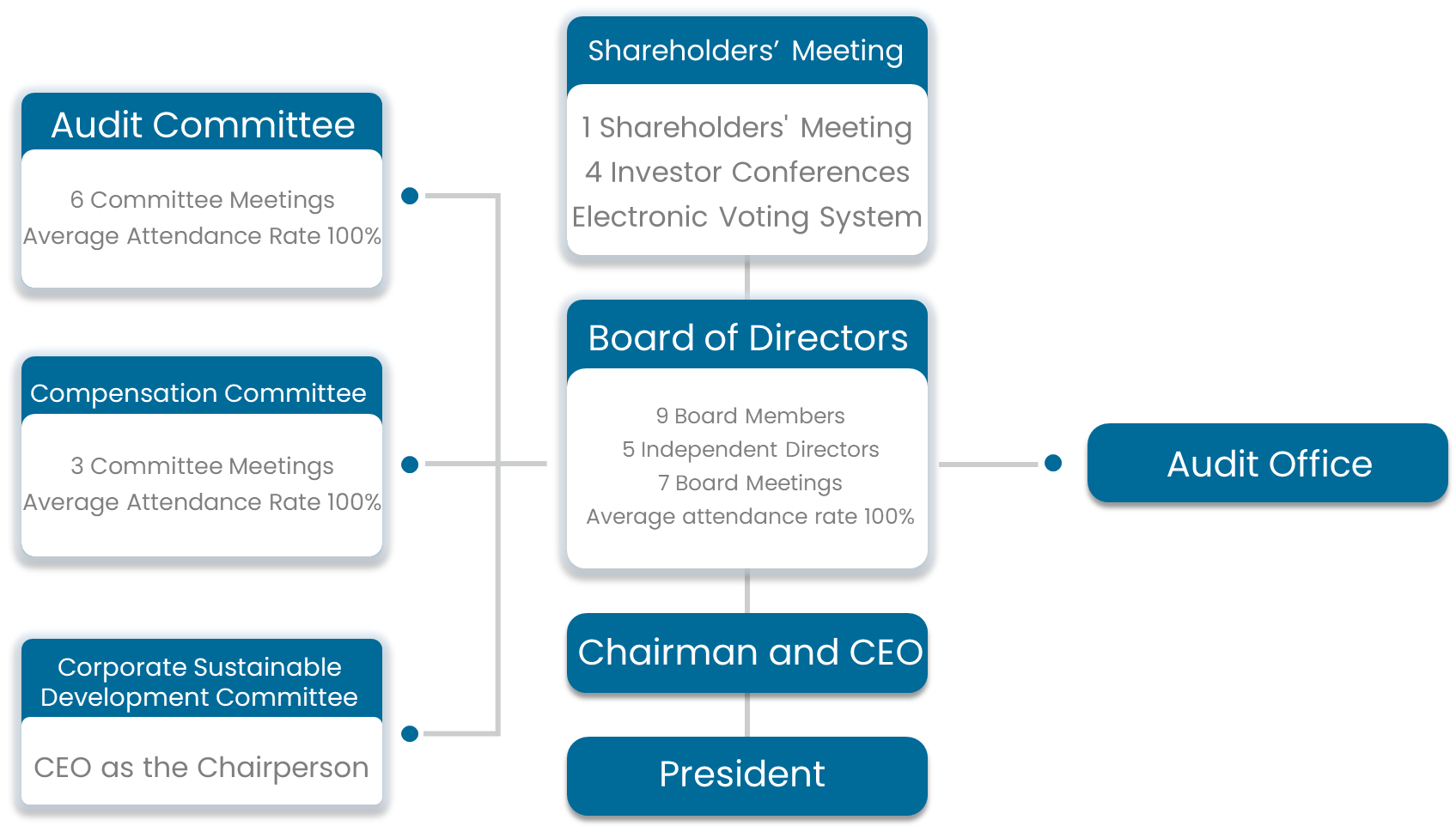
Corporate governance is the foundation of business operations. Qisda has a management team composed of experienced professional managers. Board members generally have the knowledge, skills and accomplishments necessary to perform their duties. With a sound organizational structure, sound corporate governance is implemented. From 2015, the Corporate Sustainable Development Committee is responsible for supervising and managing the promotion of the company's sustainable business strategy, and regularly reports to the board of directors on the implementation of the year in order to communicate with the directors on related issues.
Organizational Structure of Corporate Governance
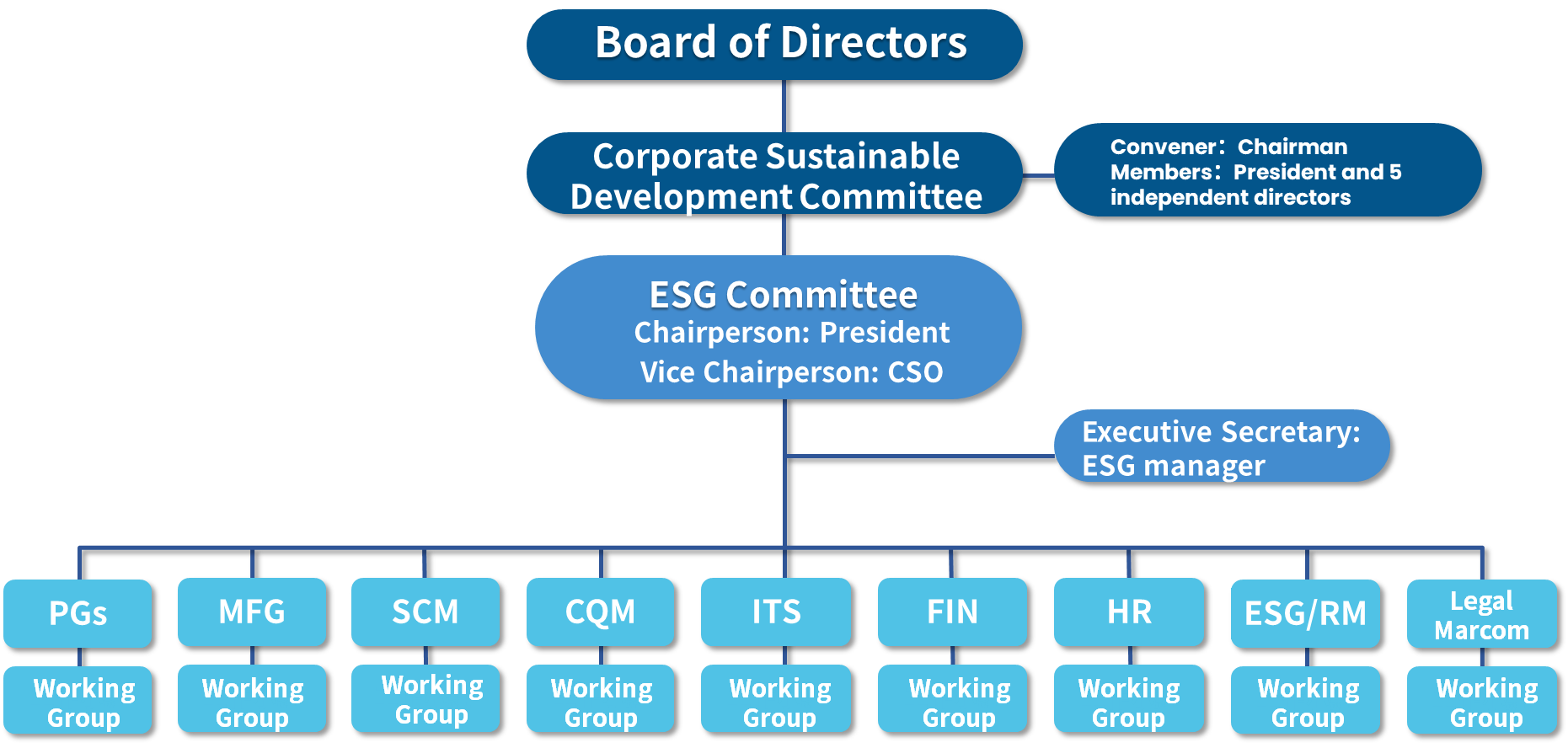
ESG Committee
In order to smoothly conduct ESG affairs and ensure the communication for and responses to the stakeholders’ suggestions on our business, Qisda has integrated the relevant departments to form the ESG Committee. The President, Joe Huang, serves as the chairperson while the senior managers of relevant departments act as the committee members of different dimensions. The Chief Sustainability Officer serves as the vice chairperson and is responsible for establishing and planning matters related to corporate sustainable development. Moreover, the ESG unit coordinates, promotes and guides the implementation by the department concerned.
ESG Committee convenes at least once a quarter. The Chairman and President preside over the meeting together to direct and supervise the senior managers. The committee members of different dimensions report the implementation status of the performance indicators and the progress of the corporate sustainable development relevant issues. Currently, the Committee monitors and discusses 51 indicators. It has held 75 meetings to date. Sustainability personnel and the personnel of each task force perform information and performance validation to ensure the consistency, completeness and accuracy of data.
- When any omissions are found, the data will be returned to the head of each department to complement and confirm the information. At the final stage, it should be disclosed after the approval of the ESG Committee. In addition, according to Qisda’s “Guidelines for Corporate Sustainable Development,” material topics of the year, sustainability performance and the management results of climate governance related issues are reported to the Board of Directors every year on a periodic basis.
Remuneration System for Managers
Remuneration Structure and Short and Long-term Incentive Plans for Senior Managerial Officers
The "Compensation Policy and Principles for Senior Managerial Officers" of Qisda clearly outlines the compensation indicators, structure, and standards for senior managerial officers. In accordance with this policy
and by referencing the compensation levels of external industry peers, the Compensation Committee and the Board of Directors conduct an annual review of the compensation levels for senior managerial officers.
1. Fixed Salary
Established based on professional qualifications and aligned with market compensation levels, encompassing base salary and various allowances.
2. Short-term Incentives
Performance bonuses and employee compensation are disbursed in cash. These incentives are determined by the Company' s performance measurement indicators, which include both financial and non-financial metrics, as well as individual job level and performance, supported by a comprehensive appraisal framework.
3. Long-term Incentives
(1) Based on the positions held by senior managerial officers, a designated portion of their fixed salary is allocated, and the Company contributes an equivalent percentage as a performance-based incentive. Following the purchase of shares in the Company, the shares will be placed in a trust account, which may be linked to the Company's share price. Shares held in the Company trust account are deferred and can
be withdrawn upon resignation or retirement.
(2) The long-term incentive (LTI) plan for the senior managerial officers is structured with both a vesting schedule and a clawback provision. The long-term incentive plan for the Chairman (CEO) of Qisda and all senior managerial officers uses company performance as the evaluation criterion, and virtual shares are granted as long-term remuneration, deposited into stock trusts, linking them to future stock prices so that remuneration is highly correlated with the company's long-term operational performance. The long term incentive awards are determined based on predefined performance indicators (up to 5 years) and may be deferred for up to five years. The vested shares are distributed annually in accordance with the respective vesting schedule. Among these, the sustainability performance-related long-term incentive is expected to account for approximately 10% of the total annual compensation of senior managerial officers under the program.
4. Measurement Indicators
(1) Financial and Non-Financial Indicators
| Financial Indicators | Non-Financial Indicators | |
|---|---|---|
| Description | Return on Assets (ROA), Return on Equity (ROE), operating revenue, operating profit, accounts receivable, cash conversion cycle, etc. | Market and customer development, new business development, talent development, risk management, quality management and other operational performance metrics. |
(2) Sustainability Performance Indicators
| Sustainability-Linked KPI Items | Description | Corresponding Material Sustainability Topics | Proportion | Remarks |
|---|---|---|---|---|
| GHG emissions reduction rate | Measured as the percentage reduction in absolute Scope 1 and Scope 2 emissions compared to the base year of 2021. The target is a 30% reduction by 2025 and a 60% reduction by 2030. | Climate strategy, energy management | 25% | Climate-related performance indicators are linked to the compensation of senior managerial officers, including the Chairman (CEO), Chief Sustainability Officer (CSO), and the highest-ranking executives of each business unit. |
| The percentage of revenue generated by sustainable products | Annual revenue contribution from sustainable products | R&D and innovation of green products | 25% | |
| Employee Engagement Survey Score | Conduct the Employee Engagement Survey and keep improving the result | Talent policy | 20% | An average employee engagement score of 4.7 |
| Enhancing the scores of the Corporate Governance Evaluation and international sustainability assessments | For the governance dimension, the Company ensures alignment with global trends and stakeholder expectations through continuous improvement in international sustainability ratings | Operational and financial performance | 15% | Be selected by DJSI or MSCI, or improve by 5 points or one place in the DJSI; Improvement of one of the indicators and achieve bonus points in the domestic Corporate Governance Evaluation |
| Customer Satisfaction | The result of the customer satisfaction survey | Customer relationship management | 15% |
Note: Sustainability performance KPIs linked to senior executive compensation and certain incentive mechanisms will be implemented following approval by the Board of Directors in May 2025.
CEO Compensation
Under the deferral of bonus mechanism, 40% of the CEO's short-term incentive is granted in the form of company shares purchased through the Employee Stock Ownership Trust (ESOT). These shares are held in custody within a trust account, with a percentage deferred allowing an annual vesting/withdrawal rate of 10%. The final remaining shares in the trust account may be claimed upon resignation or retirement.
The compensation ratio of President Joe Huang to the average employee compensation is 12.4 times, and 10.8 times compared to the median employee compensation.
To align executive compensation with the Company's long-term performance and sustainable growth, the CEO's incentive compensation is linked to key financial performance indicators. The following KPIs and target values are used as part of the performance assessment framework for short-term incentives.
CEO Short-Term Incentive KPIs
KPI Indicator | Target Value |
|---|---|
Return on Equity (ROE) | Higher than the previous year's value OR |
Operating Profit | Higher than the previous year's value OR |
Net Income(PAT) | Higher than the previous year's value OR |
Scoring Principle | Met = 100 |
To further strengthen accountability and risk management, the Company has also established a clawback mechanism for executive compensation. This policy enables the Board of Directors and the Compensation Committee to recover or cancel compensation under specified circumstances where executive conduct or material events may adversely affect the Company's interests.
Clawback Policy
In the event of any of the following circumstances regarding executive compensation, the Compensation Committee and the Board of Directors may resolve to cancel, recoup, or demand the claw back of all or a portion of awarded or unvested compensation:
- Material restatement or material misstatement of financial statements;
- Violation of laws and regulations, corporate governance guidelines, or business integrity codes;
- Involvement in material fraud, corruption, bribery, or insider trading;
- Gross negligence resulting in significant financial loss to the Company;
- Occurrence of material ESG-related incidents, including but not limited to severe occupational safety accidents, environmental contamination, cybersecurity breaches, human rights controversies, or other events causing substantia reputational harm;
- Other circumstances determined by the Board of Directors to be materially detrimental to the Company's interests.
The Company may execute such recoupment through demanding cash repayment for already paid compensation, forfeiting unvested awards, or any other lawful means. The clawback policy applies within three (3) years from the date of grant or disbursement of the relevant compensation
Tax Governance
Qisda implements tax governance. The Company's tax policy has been approved by the Board of Directors. For all operating locations, the Company adheres to local tax laws and regulations and upholds the arm's length principle in accordance with relevant requirements. The Company does not engage in aggressive tax planning, nor does it use tax structures without genuine commercial substance for tax avoidance or tax reduction purposes. It does not utilize tax havens or secrecy jurisdictions for tax avoidance activities. Tax-related information is disclosed in the financial statements and local tax filings to stakeholders to enhance transparency. The Tax Department is the responsible unit for tax governance within the Company, while the finance departments of major subsidiaries are also responsible for tax-related matters. All of the Company's significant transactions and decisions are structured in accordance with local tax laws and applicable tax treaties. The Company regularly confirms with each operating site that day-to-day transactions comply with relevant tax regulations. In the event that tax authorities raise inquiries regarding any transactions of the Company or its major subsidiaries, the Tax Department of the Company establishes dedicated projects to communicate and coordinate with the relevant tax authorities. In addition, the Company files its Country-by-Country Report (CbCR) for the preceding year in accordance with regulations at the end of each year, and also submits secondary filings in the Netherlands to facilitate access by tax authorities outside Taiwan.
2024 and 2025 Tax Information for Qisda Group
Unit: TWD in Thousands
Tax Metrics | 2024 | 2025 |
|---|---|---|
Profit before Tax | 4,648,397 | 2,827,896 |
Income Tax Expense | 1,834,199 | 1,435,852 |
Effective Tax Rate (%) | 39.46 | 50.77 |
Income Taxes Paid | 1,926,520 | 1,888,466 |
Cash Tax Rate (%) | 41.44 | 66.78 |
Note: Please refer to the Qisda Group 2025 consolidated financial statements for detailed information.
Tax Information by Jurisdiction
2025
Unit: TWD in Thousands
| Tax Jurisdiction | Revenue | % | Profit (Loss) before Tax* | % | Income Tax Expense Accrued (Current Year) | % | Income Tax Expense Paid (Cash Basis) | % | Number of Employees |
|---|---|---|---|---|---|---|---|---|---|
| AUSTRIA | 798,729 | 0.22 | 6,002 | 0.21 | 1,888 | 0.13 | 1,948 | 0.10 | 11 |
| CANADA | 497,906 | 0.13 | 20,164 | 0.71 | 4,708 | 0.33 | 867 | 0.05 | 22 |
| CHINA | 98,541,268 | 26.55 | 2,947,600 | 104.23 | 940,065 | 65.47 | 916,909 | 48.55 | 12,434 |
| FRANCE | 451,247 | 0.12 | 5,818 | 0.21 | 1,472 | 0.10 | 1,352 | 0.07 | 16 |
| INDONESIA | 519,715 | 0.14 | 64,636 | 2.29 | 28,991 | 2.02 | 16,037 | 0.85 | 83 |
| ITALY | 168,951 | 0.05 | 1,907 | 0.07 | 691 | 0.05 | - | 0.00 | 12 |
| JAPAN | 4,742,680 | 1.28 | 68,028 | 2.41 | 15,363 | 1.07 | 2,241 | 0.12 | 84 |
| KOREA | 524,334 | 0.14 | 30,012 | 1.06 | 7,562 | 0.53 | 10,643 | 0.56 | 21 |
| SWEDEN | 359,078 | 0.10 | 1,892 | 0.07 | 728 | 0.05 | 3,826 | 0.20 | 7 |
| TAIWAN (REPUBLIC OF CHINA) | 181,767,004 | 48.97 | 24,765 | 0.88 | 635,103 | 44.23 | 731,684 | 38.74 | 11,265 |
| UNITED STATES | 46,144,762 | 12.43 | 528,884 | 18.70 | 122,500 | 8.53 | 124,966 | 6.62 | 348 |
| Other | 36,662,185 | 9.88 | (871,811) | (30.83) | (323,218) | (22.51) | 77,994 | 4.13 | 5,392 |
| Total | 371,177,860 | 100 | 2,827,896 | 100 | 1,435,852 | 100 | 1,888,466 | 100 | 29,695 |
*Profit (Loss) before Tax does not include investment income (loss) recognized under equity method.
2024
Unit: TWD in Thousands
| Tax Jurisdiction | Revenue | % | Profit (Loss) before Tax* | % | Income Tax Expense Accrued (Current Year) | % | Income Tax Expense Paid (Cash Basis) | % | Number of Employees |
|---|---|---|---|---|---|---|---|---|---|
| AUSTRIA | 650,782 | 0.17 | 7,246 | 0.16 | 1,949 | 0.11 | 1,388 | 0.07 | 11 |
| CANADA | 559,408 | 0.15 | 2,810 | 0.06 | 1,442 | 0.08 | 433 | 0.02 | 5 |
| CHINA | 117,429,995 | 31.53 | 3,726,139 | 80.16 | 996,900 | 54.35 | 697,469 | 36.20 | 10,345 |
| FRANCE | 436,093 | 0.12 | 3,872 | 0.08 | 1,251 | 0.07 | 1,225 | 0.06 | 19 |
| INDONESIA | 567,294 | 0.15 | 78,880 | 1.70 | 18,723 | 1.02 | 21,880 | 1.14 | 82 |
| ITALY | 183,385 | 0.05 | 3,026 | 0.07 | 1,229 | 0.07 | 4,150 | 0.22 | 9 |
| JAPAN | 4,698,844 | 1.26 | 59,131 | 1.27 | 10,558 | 0.58 | 31,976 | 1.66 | 70 |
| KOREA | 492,788 | 0.13 | 8,911 | 0.19 | 2,245 | 0.12 | 6,859 | 0.36 | 18 |
| SWEDEN | 252,768 | 0.07 | 4,340 | 0.09 | 1,536 | 0.08 | 1,432 | 0.07 | 7 |
| TAIWAN (REPUBLIC OF CHINA) | 173,065,558 | 46.47 | 2,952,726 | 63.52 | 816,189 | 44.50 | 1,068,873 | 55.48 | 10,099 |
| UNITED STATES | 45,065,587 | 12.10 | 46,639 | 1.00 | 35,483 | 1.93 | 22,940 | 1.19 | 234 |
| Other | 29,056,558 | 7.80 | (2,245,323) | (48.30) | (53,304) | (2.91) | 67,896 | 3.52 | 2,730 |
| Total | 372,459,062 | 100 | 4,648,397 | 100 | 1,834,199 | 100 | 1,926,520 | 100 | 23,629 |
*Profit (Loss) before Tax does not include investment income (loss) recognized under equity method.




Want to know more detailed content?
Read Report Contents